
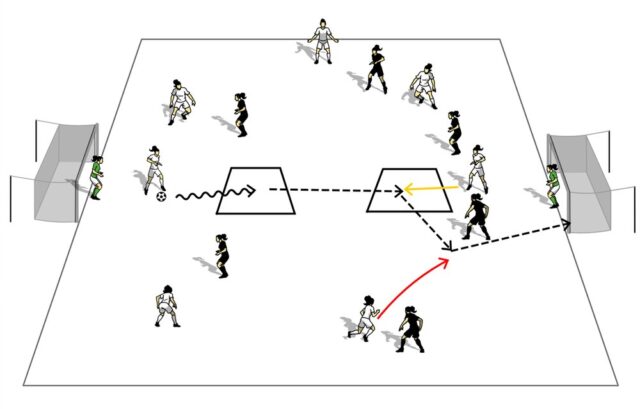
Good football passing drills do two things at once: they sharpen the technique of the pass itself, and they force players to decide who to pass to, when, and why. The passing activities for soccer below are taken from seven Bennion Kearny and Hawksmoor coaching books, and range from a simple passing diamond through to position-specific work for central defenders. Each one includes the set-up, the coaching points and the progressions, so you can take it straight to training.
Passing is the first skill most coaches teach and the last one any player stops working on. The difficulty is that a drill which looks busy is not necessarily a drill that improves anybody. A line of players knocking the ball back and forth will groove a technique, but it will never teach a midfielder when to turn and play forward, or a centre-back when to drive into space rather than recycle possession.
What follows is a progression. We start with the five passing techniques every player needs, then move through passing drills for soccer that add opponents, decisions and pressure — the things that make a pass difficult in a match.
The five passing techniques

Before the drills, the techniques. These five passes cover almost everything a player will need, and each one has a handful of checkpoints a coach can watch for.
From The Golden Age of Player Development by Rob Porter.
Short passing
This is where players make a quick, accurate pass over a short distance, typically less than 10 yards.
- Look at the ball, target, ball.
- Non-kicking foot to the side and level with the ball.
- Strike the ball with the inside of the foot.
- Ankle locked.
- Strike through the centre of the ball to stop the ball from bobbling.
- The striking foot follows through in the direction the ball is aimed.
- Body upright, with head and knee over the ball.
- Passing factors: accuracy, weight, timing, disguise.
Lofted passing
This technique is useful when a player needs to lift the ball into the air over a distance. It is often used to bypass an opponent or change the direction of play.
- Look at the ball, target, ball.
- Non-kicking foot to the side and slightly behind the ball.
- Strike the ball with the instep or laces.
- Ankle locked.
- Strike the bottom third of the ball to get height.
- The striking foot follows through in the direction the ball is aimed.
- Body leaning back slightly, to help loft the ball.
Swerve passing
This is where the ball curves in its trajectory due to the way it is struck with the outside of the foot.
- Look at the ball, target, ball.
- Angled approach to the ball.
- Non-kicking foot away and slightly behind the ball.
- Strike the ball with the outside or inside of the foot (nearer toes).
- Aim to strike the outside third of the ball.
- Wrap the foot around the ball for a longer contact.
Driven passing
A driven pass is a powerful, ground-level pass that travels a long distance.
- Look at the ball, target, ball.
- Straight or slightly angled approach to the ball.
- Non-kicking foot alongside the ball.
- Strike the ball with the laces.
- Strike through the middle of the ball.
- Straight follow-through.
Chip passing
This is where the ball is kicked with the toe or instep, lifting the ball into the air.
- Look at the ball, target, ball.
- Straight approach to the ball.
- Non-kicking foot close to the striking foot.
- Stab at the underneath of the ball with a straight foot.
- No follow-through.
1. Modified passing diamond

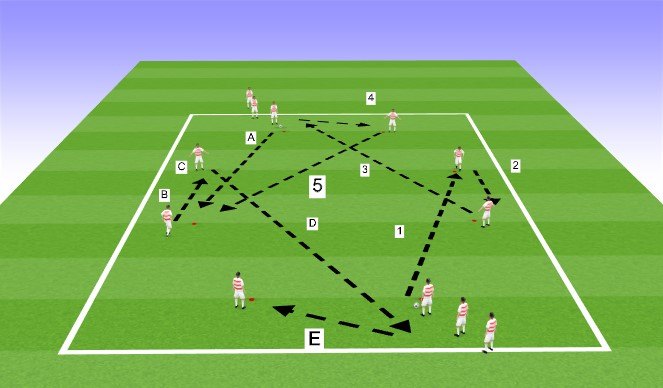
A two-ball passing pattern, and the best place to start if you want a warm-up that still demands accuracy, weight and movement. The area can be manipulated to work on both short and long passing, and a larger area will give your players more thinking time. Work for a set period in one direction, then work in the opposite direction.
From Through the Thirds by Tony Mee.
How to play
- A two ball exercise, with the balls starting in the position shown.
- Passes are made in the order shown (on the left A-B-C-D-E, on the right 1-2-3-4-5).
- The passer follows his pass and takes the place of the player at that disc.
- Try to play in one or two touches.
Coaching points
- Pace and accuracy of the pass.
- Receiver to make a check movement and indicate where he wants the ball.
- On the short passes, try to leave the ball playable for the next player — don’t pass a problem on to the next player.
- Follow the pass at pace.
Progression
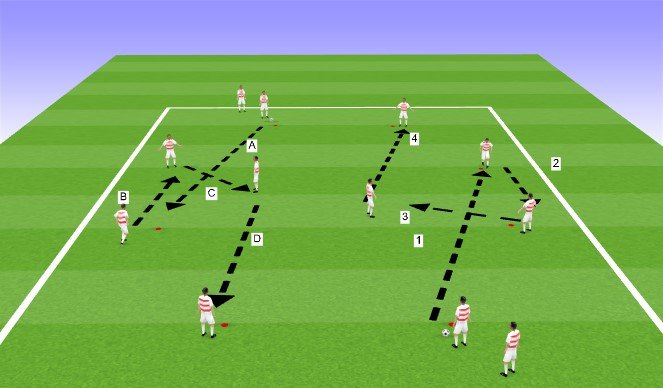
Add another player in the centre of the pitch on each side. The practice then continues, as illustrated.
2. Midfield forward passing game
The warm-up grooves the technique; this one adds the decision. The purpose is to encourage correct body shape and forward passing from midfielders — the single habit that separates a midfield that progresses the ball from one that passes sideways.
From Deliberate Soccer Practice: 50 Passing & Possession Football Exercises by Ray Power.
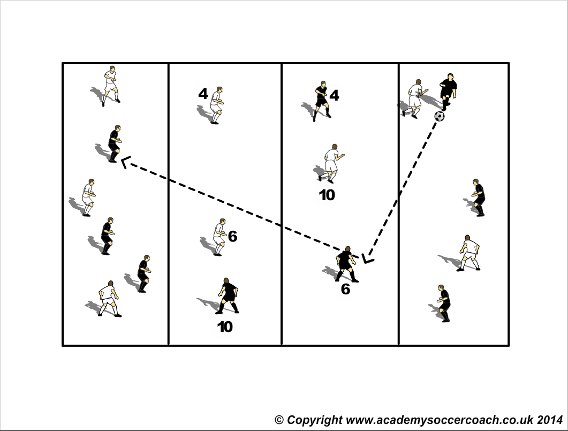
Set-up and instructions
- Whites v. blacks play in the four defined areas as shown.
- Two central zones contain three midfielders from each team, with a 2v1 in both areas.
- The play begins in an outside area. Teams must keep possession and work the ball into any of the three midfield players.
- To score, the midfielder can a) combine to play a one-touch pass forward, or b) play a first-time one-touch pass into the opposite end area.
- The team that scores keeps possession and looks to play in the opposite direction.
Progressions and regressions
- After a forward pass, the three midfielders must rotate positions.
- A team gets two points if the pass goes from one end area to the other, with only one touch from a midfield player.
3. Playing between the lines to attack in central areas

A full-pitch practice built around the pass into the pocket of space between an opponent’s midfield and defence — the pass that breaks a block open.
From Maximise Your Training Sessions by Rob McKay.
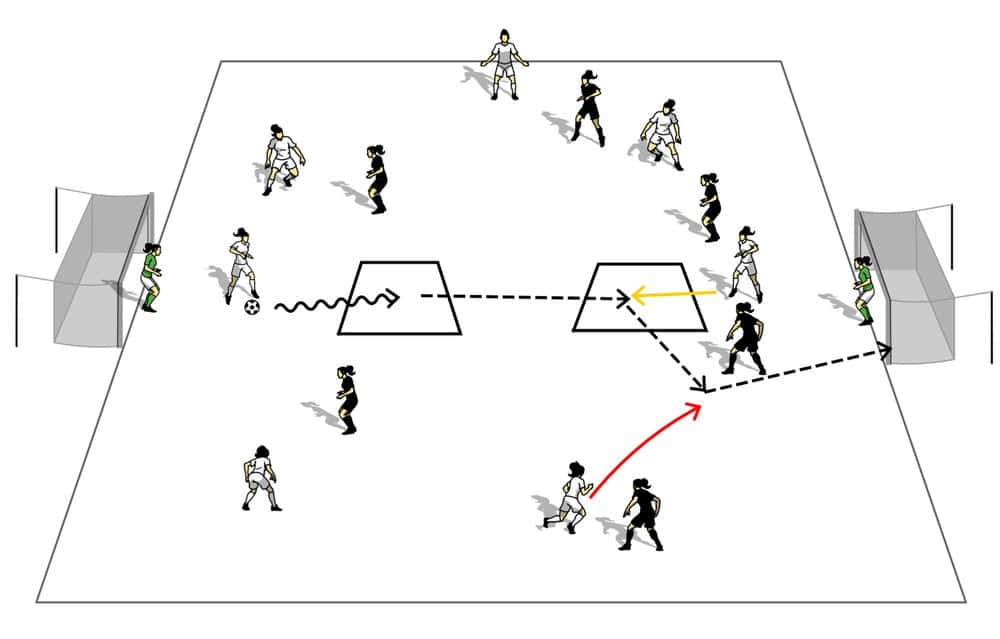
Conditions
- Play starts with the goalkeeper, and players are not restricted to where they can play.
- There are two free zones located centrally, which can be dribbled into unopposed, or where players can drop in to receive the ball.
- Players cannot stand in these areas and must time their runs to receive passes.
Coaching points
- Encourage defensive players to break lines and step out with the ball.
- Encourage attacking players to drop in between the lines to receive.
- Create passing options once a player has moved into the free zone.
- Encourage vertical movement outside any free zone.
Progression
- Allow defensive players to follow attacking players into the free zone to create 1v1s.
- Remove the free zones and encourage players to continue the theme of the session.
4. Breaking lines in wide areas
The same principle moved to the flanks, where the through ball in front of a winger replaces the pass into feet.
From Maximise Your Training Sessions by Rob McKay.
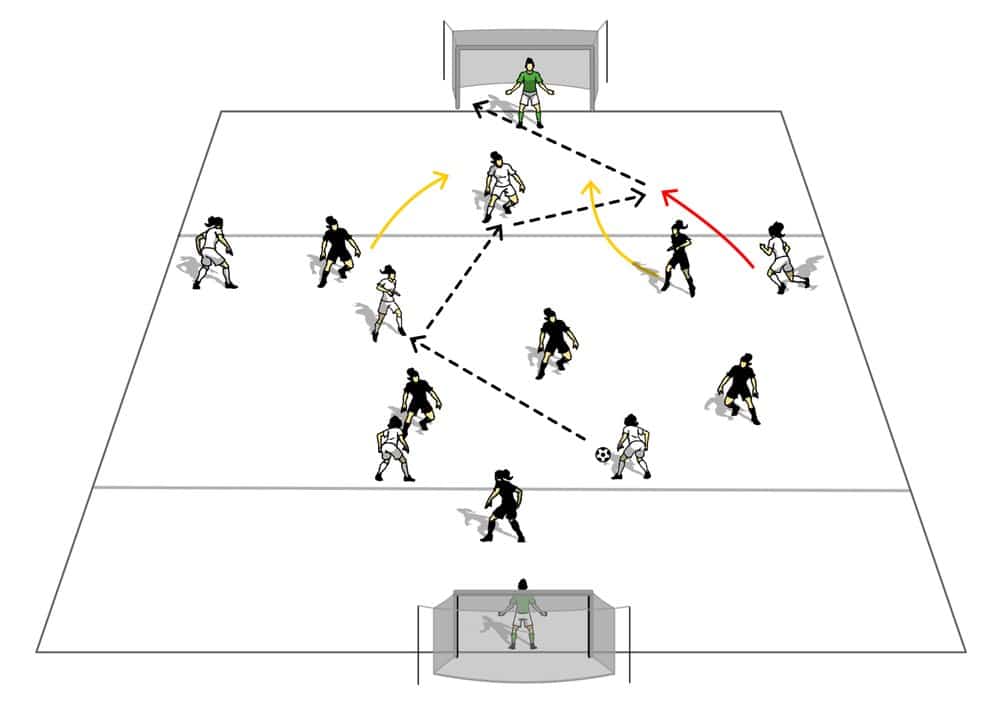
Conditions
- Players start in the middle zone with the exception of the centre forwards and goalkeepers.
- Play always begins in the middle zone.
- The possession team looks to break a line into the final third by either playing into the centre forward or by the wingers running onto a through ball.
- Two attackers can join the centre forward in the attack, whilst two defenders can drop into the defensive zone.
Coaching points
- Triggers to start the attack.
- Through balls in front of the wide players.
- Third man runs off the ball.
- Stretch the play.
Progression
- Increase the number of attackers and defenders allowed into the end zone.
5. Counter-press: 4v4 + 3

A passing and possession exercise made famous by Pep Guardiola and used by many coaches. The three white players support the team in possession, and the white players at the top and bottom are free to move anywhere along their line. The white in the centre may move anywhere inside the area.
From Football’s Principles of Play by Peter Prickett.
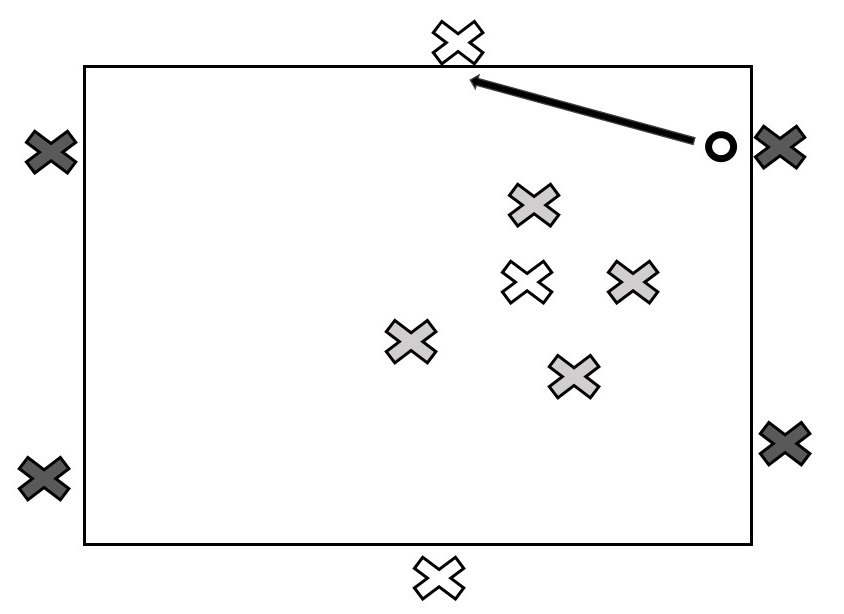
The dark team are in-possession and have two players at each end. The four grey players create pressure to regain possession. Should they regain possession, the grey players take up the positions on the end, and the dark players now attempt to regain possession. The objective is for the game to be as fluid and fast as possible, but it will take large amounts of practice to get to that level.
At the transition moment, the team that loses the ball should not relax; they should pressure the ball with ferocity. Once the in-possession team have settled into position, the out-of-possession team will press with less aggression and — instead — look for triggers such as poor passes or the ball in the air. The out-of-possession team may also be able to manipulate a situation where they cut off passing lines and isolate the player in-possession, one versus two.
6. Central defender passing under pressure

If one of your central defenders is neither comfortable in possession nor equipped with a good range of passing, they immediately hurt your team. There are two different ways an opposing team can exploit this type of central defender: they can press and exert immediate pressure; or they can drop off, let the central defender have time and space, and then pick off the pass. Both scenarios will result in a counter attack where the defensive team will have players out of position and will run the risk of conceding. This exercise works on central defenders coming out of the back with time and space, looking to play a good pass into midfield, whilst running the risk of having the ball intercepted.
From The Modern Soccer Coach: Position-Specific Training by Gary Curneen.
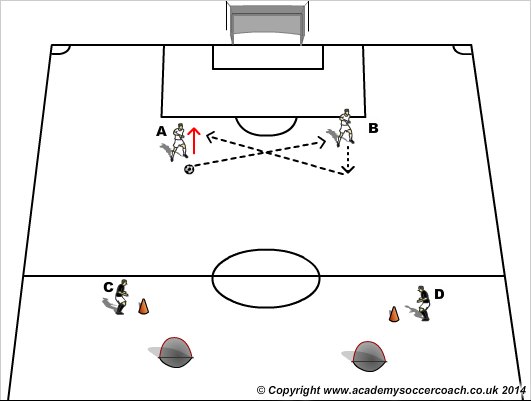
The practice is ideal for a central defensive pairing and there are also two players who act as interceptors in the middle. Play takes place in the middle of the field, with two mini-goals located ten yards inside the other half. The two interceptors have to start on their respective cones and cannot enter the half that the central defenders occupy.
Organization
Play starts with two central defenders (A and B) passing the ball back and forth. Although a basic start, both defenders should always take one touch forward, then pass the ball diagonally backwards to the partner — then, after passing the ball, the defender should drop off to create a new angle. This passing pattern is critical for any central defensive pairing and means that there are no square passes or forward passes, both of which are a disaster for any team in possession (if the defending team intercepts). During this time, the interceptors (C and D) simply wait by their cones.
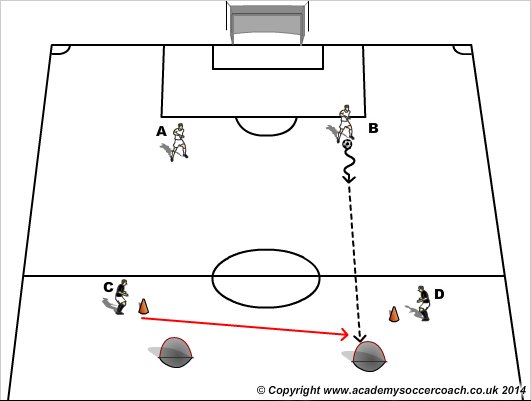
After approximately 30-45 seconds, on the coach’s signal, the central defender who receives the next pass must then drive forward towards the halfway line at full speed. Then after two or three touches, the defender must try and pass it into the mini-goal ahead. On the same signal, the interceptor opposite the central defender who is in possession must sprint across and try to block the pass in front of the mini-goal. The central defenders get one point for a goal, while the interceptors get one point for a save.
Coaching points
- The role of the interceptor sprinting across challenges the central defender who is in possession in two ways: 1) How quickly he/she can drive up the field and exploit the space ahead. 2) The weight and accuracy of the pass under pressure.
- If the central defender misses the target, you most likely have run into a technical problem. The solution may be in how the central defender sets their feet before making the pass.
- If the interceptor continually saves the pass in front of the mini-goal, the weight of the pass needs to be stronger.
- Encourage the passing between central defenders at the start of the exercise to be crisp and sharp. This will set the tone for their progression and give them the confidence to drive forward and pass into the goal.
Progression
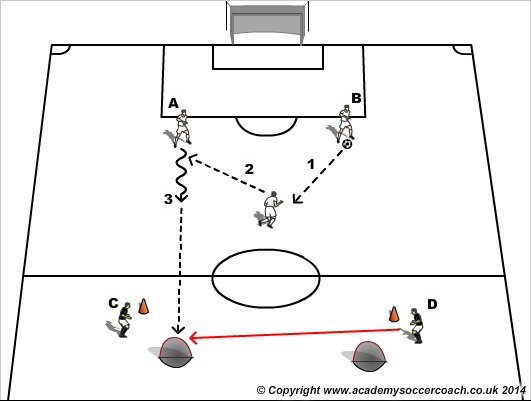
The central defensive pairing is now joined by a holding midfielder and they begin the exercise by passing in a triangle in any order. Make sure play does not become predictable between the three players as this will lead to complacency. Now, on the coach’s signal, the player in possession must play into the holding midfielder, who then must transfer the ball quickly to the oncoming central defender on the other side. The central defender who receives the ball (A, in the picture above) must drive forward with one or two touches and must then pass into the mini-goal straight ahead. The interceptor comes from the same line as the first passer and performs the same role as from the first phase — stopping the ball from going into the mini-goal.
A third progression is that the central defender (player A or B) can now pass into either mini-goal. This gives them the option of a diagonal pass. Their decision should be dictated by what side has the most space.
7. Back to goal finishing

Passing drills for soccer are usually framed from the passer’s point of view. This one is framed from the receiver’s — because a pass into a forward is only as good as the body shape waiting to meet it.
From Developing Soccer Players: Forward-Specific Practices by Dan Bolas.
Practice
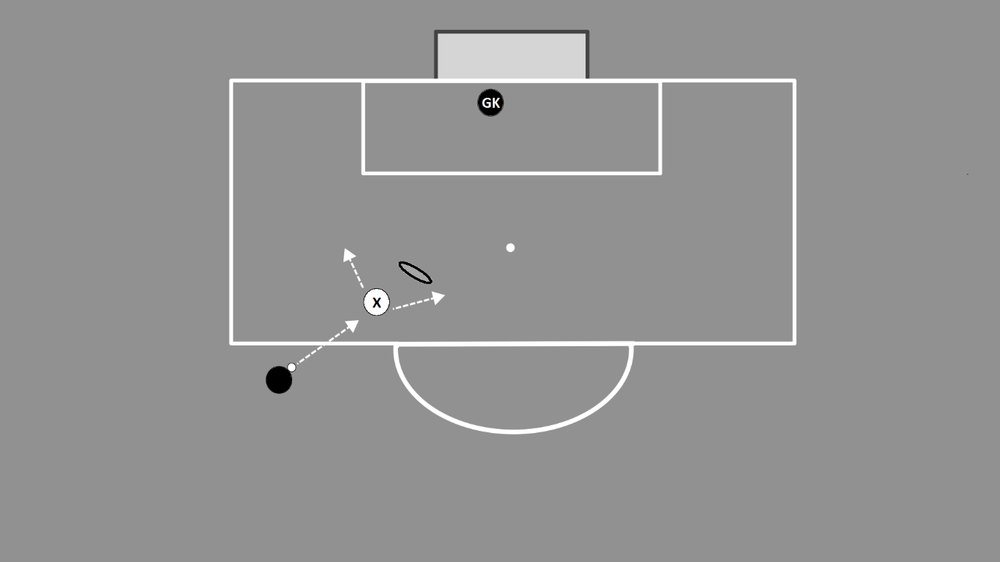
- The forward (X) starts by backing in towards the mannequin, before changing body shape to being sideways on to the coach.
- Coach touches the ball, out of feet, and passes into the forward.
- Forward takes one touch to turn before getting a shot away with a second touch past the GK.
- Forward can turn either way (inside or outside).
- Run the practice from both sides to develop turning and finishing from different angles.
- 1 repetition = 6 shots.
Key technical points
- The trigger for the forward to change body shape is the coach’s touch.
- The forward’s body shape should be sideways on, to create distance between the ball and mannequin.
- Forward to turn with the front foot (the foot furthest away from the defender).
- Practice using both the inside and outside of the foot to turn.
- Finishing with laces or inside of the foot.
Coach’s tip: encourage the forward to have their arm out to feel for the mannequin. Encourage the spin and shot to be quick.
How to build a session from these passing activities
Used on their own, each of these is a useful twenty minutes. Used in sequence, they make a coherent session. A straightforward way to put one together:
- Warm-up: the modified passing diamond, which gets touches and movement in without any opposition.
- Technical focus: pick one of the five passing techniques and coach it explicitly, so players have a checkpoint to think about.
- Decision-making: the midfield forward passing game, or the counter-press, where the pass now has to beat somebody.
- Transfer to the pitch: playing between the lines or breaking lines in wide areas, on a full pitch with real distances.
- Position-specific work: the central defender exercise or back to goal finishing, for the players whose job that actually is.
The thread running through all of them is that a pass is a decision before it is a technique. Drills that remove the decision will make your players tidier in training and no better on a Saturday.
The books these drills come from
Every practice above is reproduced from one of the following, and each book contains many more:
- The Golden Age of Player Development by Rob Porter
- Deliberate Soccer Practice: 50 Passing & Possession Football Exercises by Ray Power
- Through the Thirds by Tony Mee
- Maximise Your Training Sessions by Rob McKay
- Football’s Principles of Play by Peter Prickett
- Developing Soccer Players: Forward-Specific Practices by Dan Bolas
- The Modern Soccer Coach: Position-Specific Training by Gary Curneen