
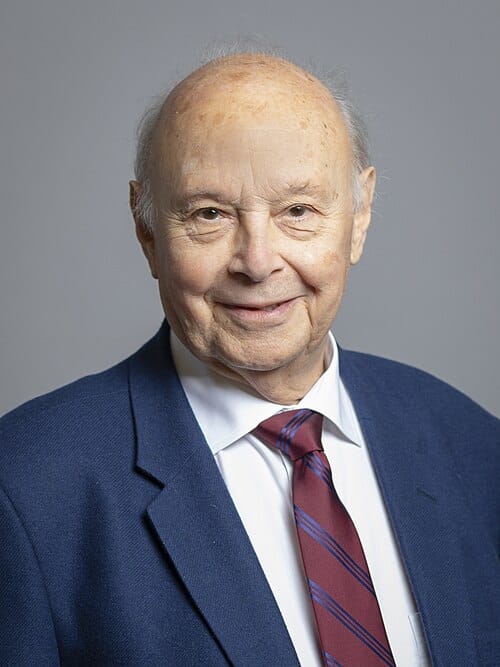

Leslie Turnberg — Lord Turnberg of Cheadle — was born in Manchester in March 1934 and grew up in the backstreets of Salford. He went to Manchester University to read medicine in 1952, qualified in 1957, and trained in Manchester and London before settling on gastroenterology, the speciality he practised as a consultant in Salford for the rest of his clinical career.
He became professor of medicine at the University of Manchester in 1973, based at Hope Hospital, and held the chair until 1997. From 1983 to 1986 he was dean of the medical school, where he rebuilt the curriculum around problem-based learning — students working from real clinical problems rather than sitting through lectures — an approach that was unusual in Britain then and is ordinary now. He sat on the North West Regional Health Authority through the second half of the 1980s, and has written some 150 papers on medical and scientific research.
From 1992 to 1997 he was President of the Royal College of Physicians, the years in which the Academy of Medical Sciences was founded; he went on to serve as the Academy’s vice president. He was knighted in 1994 for services to medicine and made a life peer in 2000. The list of what he has chaired and presided over since is long: the Public Health Laboratory Service board, the Medical Protection Society, the Association of Physicians, the Medical Council on Alcoholism, the UK Forum on Genetics and Insurance, and the National Centre for the Replacement, Refinement and Reduction of Animals in Research. He is scientific adviser to the Association of Medical Research Charities, a trustee of the Wolfson Foundation and of Ovarian Cancer Action, and a patron of ASH.
His writing has not stayed inside medicine. Forks in the Road: A Life In and Out of the NHS is the memoir of the Salford boy who ended up in the House of Lords, and it is as much about the relationship between politics and medicine as about either on its own. Beyond the Balfour Declaration and Mandate: Britain’s Palestinian Burden turn to the history of Britain in Palestine, a subject he has pursued with the same appetite for primary sources that he brought to research medicine.
Patients First returns him to the health service. It is written from inside six decades of it — as a junior doctor, a consultant, a professor, a college president and a legislator — and it is neither a defence of the NHS nor an attack on it, but an argument about what putting patients at the centre of the thing would actually require, and what it would cost to get there.
Photo by Roger Harris, licensed under CC BY 3.0.